Intro
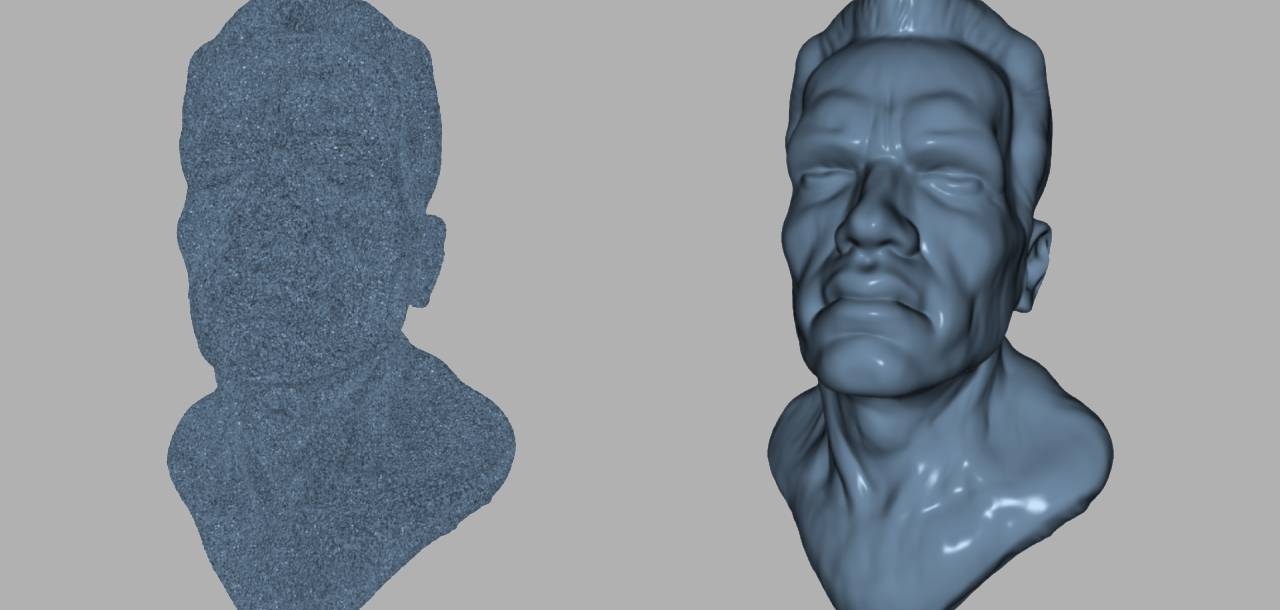
Notes from implementing the mean curvature algorithm of Discrete Differential-Geometry Operators for Triangulated 2-Manifolds (Meyer et al.). Curvature is computed per vertex with no dependency between vertices, so the whole thing maps well onto CUDA. I never benchmarked it against a CPU version, so don’t read this as a speed comparison.
Code’s on github if you want to follow along.
Quick algorithm explanation
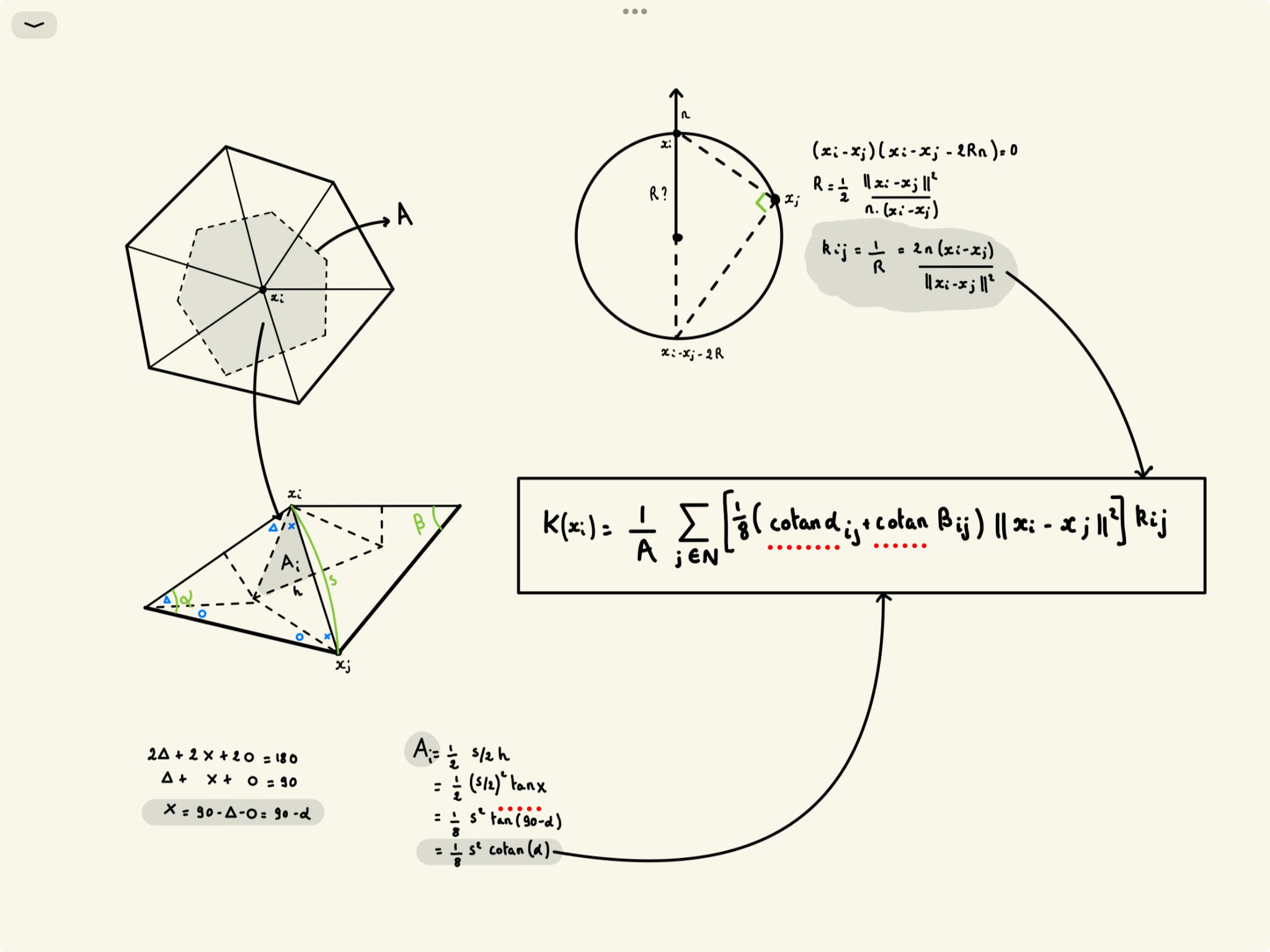
The point of this algorithm is anisotropic smoothing: it smooths the surface but keeps features like the sharp angle between the nose and the cheek. A plain Laplacian smooth would eat them.
Each vertex gets a delta D built from its curvature K and a weighted Voronoi area, and moves along its normal by that amount: v(i) = v(i) + n(i) * k_v(i), with k_v(i) combining the Voronoi area and the mean curvature of the ring’s edges.
Algorithm implementation
Procedure
- Load the mesh, add random noise.
- Build host rings and edges.
- Build the CUDA rings and edges, copy them to the device.
- Copy vertices and normals over.
- Scale vertices up by the smallest edge length. Depending on the mesh’s units, edges can be tiny and the numerics fall apart.
- Run the curvature kernel n times, n being user-defined.
- Scale back down.
- Recompute normals.
- Copy data back to host and clean buffers.
Data layout
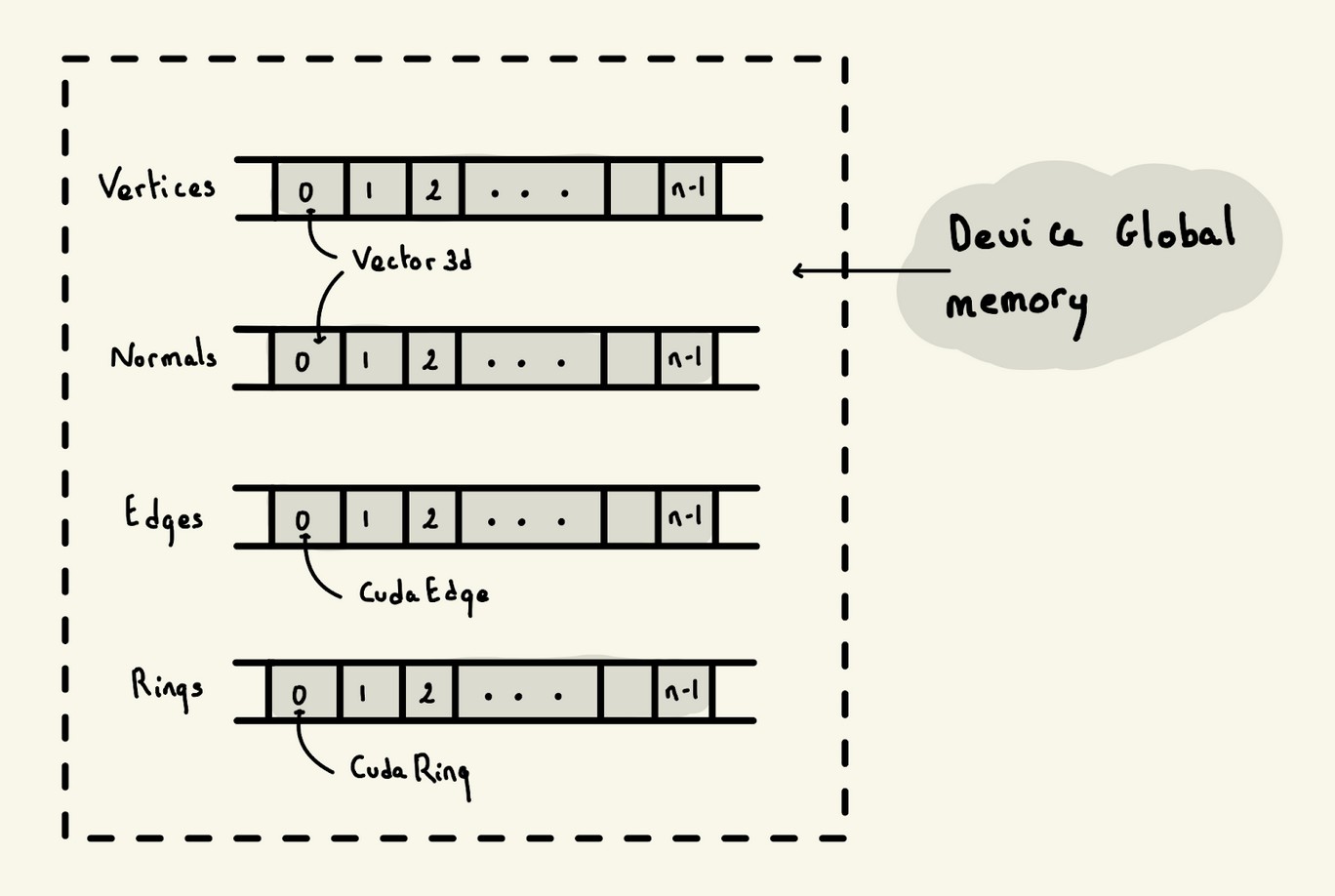
Everything sits in four contiguous arrays in device global memory.
Vertices & Normals
Vertices and normals are Eigen::Vector3d, same as open3d, the library I use to load the mesh.
CUDA Rings
class CudaRing {
    // Rings are characterized by a center vertex ID and pointers to corresponding edges
    VertexId center_;
    CudaEdge *edges_;
    int edges_count_ = 0;

public:
    // Public method to compute the Ring's mean curvature and update the center's position
    __device__ void ComputeCurvature(Eigen::Vector3d *positions,
                                     Eigen::Vector3d *normals);
};
CUDA Edges
struct CudaEdge {
    VertexId end;      // endpoint of an edge in a ring
    VertexId adjs[2]; // adjacent vertices of the {end} vertex in the ring
};
Kernels
Three kernels, that’s it.
__global__ void OptimizeMeanCurvature(CudaRing *rings, int n,
                                       Eigen::Vector3d *positions,
                                       Eigen::Vector3d *normals) {
    int i = threadIdx.x + blockIdx.x * blockDim.x;
    if (i < n) {
        rings[i].ComputeCurvature(positions, normals);
    }
}

__global__ void GetSmallestEdgesLengths(CudaRing *rings, int n,
                                        Eigen::Vector3d *positions,
                                        double *out) {
    int i = threadIdx.x + blockIdx.x * blockDim.x;
    if (i < n) {
        out[i] = rings[i].GetSmallestEdgeLength(positions);
    }
}

__global__ void ScalePositions(Eigen::Vector3d *positions, int n,
                               float amount) {
    int i = threadIdx.x + blockIdx.x * blockDim.x;
    if (i < n) {
        positions[i] *= amount;
    }
}
Result
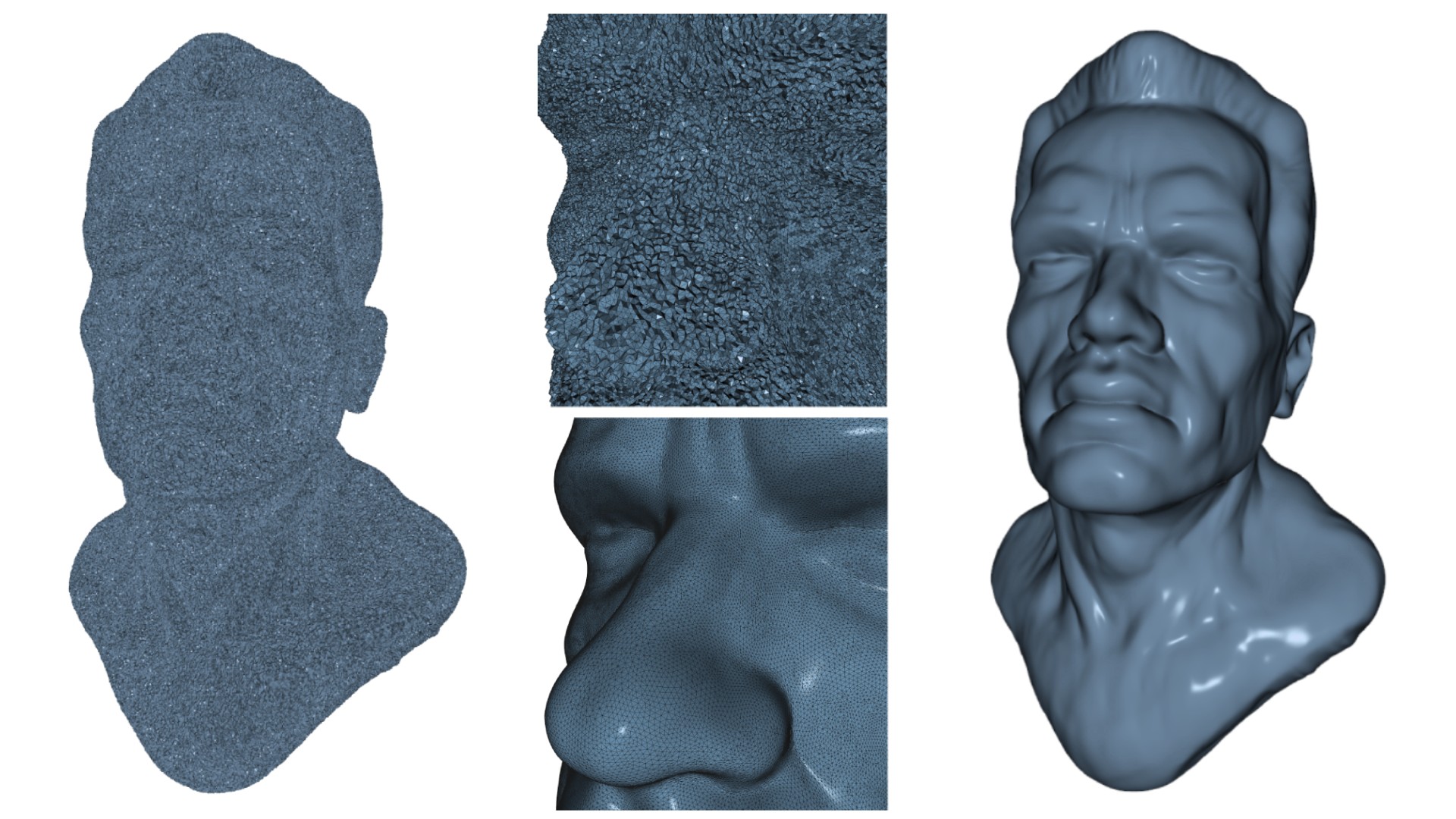
(Left - middle-top) the mesh before optimization (middle-bottom - right) the mesh after optimization.
The noise is gone, the anisotropic part does preserve facial features.
On my RTX 3080 the whole thing takes about 1300ms on a 667841-vertex mesh with 30 iterations. The ComputeCurvature kernel alone averages 19ms, so 30 iterations only account for about 570ms of that. The rest goes to everything around the kernel: ring construction, host-device copies and scaling passes.
Expected caveat: quality degrades on meshes with irregular topology, especially with near-degenerate triangles.
Note
Thanks to atanazy for the free model on turbosquid.